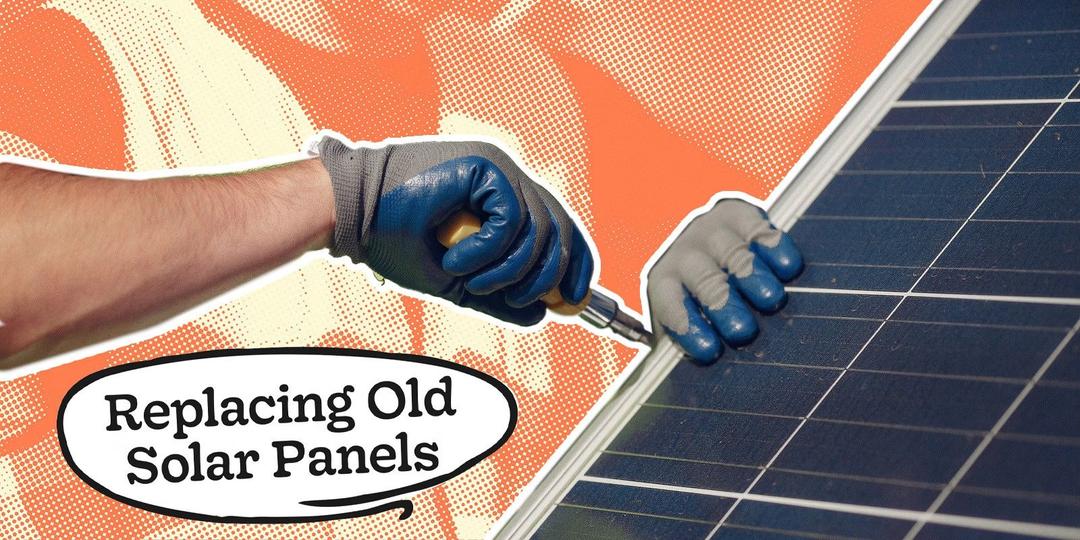

If you’re looking up at solar panels that went on your roof back when David Cameron was still doing the “green future” tour, it’s fair to wonder whether they’re still pulling their weight.
- [1] Do you need to replace old solar panels?
- [2] How long do solar panels last in the UK?
- [3] The most common reasons people replace panels
- [4] Replace panels vs add more panels vs replace the inverter first
- [5] Compatibility and “can you mix old and new panels?”
- [6] The FiT question - will replacing panels affect your Feed-in Tariff?
- [7] Costs - what does it cost to replace old solar panels?
- [8] What happens to the old panels?
- [9] What to do before you replace anything (quick checklist)
- [10] So…should you replace your panels?
Maybe your bills are creeping up. Maybe you’re adding an EV charger, a heat pump, or a battery - and your current setup feels a bit…2010.
If you’re a UK homeowner with an ageing solar system (roughly 8–20+ years old), you’ve got a few realistic routes - upgrade, expand, repair, or simply leave the things alone.
This guide is here to help you make the call without the hard sell. We’ll break down when replacement actually makes financial sense, when it’s a waste of money, and the key “gotchas” people miss - like FiT paperwork, warranties, and whether your inverter is the real problem (not the panels).
PS We offer MCS-certified solar panel installation nationwide. Simply answer these questions, get your fixed price and arrange your free design.
🔑 Key takeaways:
Old panels rarely need replacing - most just degrade slowly.
Low output? Check the inverter first (often fails before panels).
Need more power (EV/heat pump/battery)? Adding panels can be better value than a full swap (space + DNO/export limits permitting).
Replace when there’s damage or roof work (cracks, hotspots, repeat faults, re-roof).
FiT owners - check with your FiT licensee before making changes.
Costs - full replacement is often £5k–£10k+; old panels must be recycled properly.
[1] Do you need to replace old solar panels?
Spoiler -probably not right this second.
Solar panels don’t usually keel over and die like an old boiler - they tend to fade gradually, like a favourite pair of trainers that still do the job…just with a bit less bounce.
Most systems keep chugging along for decades.
But replacement can make sense if you’re seeing any of these red flags:
Multiple cracked or delaminating panels - If more than a couple look like they’ve been through a hailstorm (or actually have), it’s time to take it seriously.
Consistent underperformance - If generation has dropped well below what you’d expect - and it’s not down to shading, dirt, inverter issues, or a monitoring glitch - the panels may be the problem.
Water ingress, hotspots, or repeated faults - These can be efficiency killers and potential safety risks. Don’t ignore recurring errors.
Major roof work planned - If you’re re-roofing anyway, doing panels at the same time can cut labour costs and disruption.
The goal here isn’t to panic-buy a shiny new system.
Older solar often performs perfectly well - plenty of UK installs from the 2010s still produce around 80–90% of their original output.
Replacement isn’t automatic. It’s a simple trade-off: cost vs benefit. If your panels are behaving themselves and your generation looks healthy, there’s a strong argument for leaving well enough alone.
[2] How long do solar panels last in the UK?
In the damp, grey UK climate? Surprisingly well. Solar panels are basically built to sit outside and get miserable for decades.
Most modern panels come with a 25–30 year performance warranty, typically promising you’ll still get around 80% output (or more) by the end of that period. And in the real world, plenty of systems keep working well beyond 30 years - they just fade slowly over time.
Here’s the simple breakdown:
Typical lifespan: Expect 25–30 years of strong performance, with many systems still generating beyond that (just less efficiently).
Degradation (the slow fade): A normal rate is roughly 0.5–0.8% per year.
That means after 25 years, you’re often looking at ~80–87.5% of the original output. It’s a tiny annual drop in “oomph”, not a sudden cliff-edge.
Product vs performance warranty:
Product warranty (usually 10–12 years) covers manufacturing defects.
Performance warranty (usually 25–30 years) covers the expected output decline over time.
Why inverters go first: The inverter is usually the first thing to throw a tantrum. Many need replacing after 10–15 years, while panels keep on going.
So if your system is underperforming, the inverter is often the prime suspect - not the panels.
UK weather doesn’t automatically shorten panel life. If your system is still generating decently, there’s no need for a knee-jerk replacement.
[3] The most common reasons people replace panels
Nobody wakes up and thinks, “Fancy some new solar bling?” Panel replacements are usually triggered by something practical - not boredom.
Here are the usual suspects:
Roof work - Leaks, re-roofing, dodgy battens, or felt issues often mean the panels have to come off anyway. If the scaffolding’s already up, upgrading at the same time can be the most cost-effective move.
You need more power - Adding an EV, heat pump, battery, or even a proper home office setup? Older systems can feel underpowered once your household electricity demand ramps up.
Aesthetics (or selling the house) - Old frames can look a bit naff - especially if panels are mismatched, stained, or clearly dated. Not a technical reason, but it does matter for kerb appeal and buyer confidence.
Tech upgrades - Newer panels are often 20–30% more efficient, tend to perform better in low light, and generally look sleeker. That can be a big deal if your roof space is limited and you want more generation from the same area.
Faults and damage - Storms, hail, microcracks, water ingress - the usual chaos. You might also hear about PID (potential induced degradation), which is basically a slow efficiency loss caused by electrical stress over time - like a tiny “leak” in performance rather than a sudden failure.
If none of those sound familiar, your current panels are probably doing exactly what they should. But if you’re ticking a few boxes, it’s worth digging deeper.
[4] Replace panels vs add more panels vs replace the inverter first
Ah yes - the classic dilemma: fix, extend, or overhaul?
Before you spend a penny, do the boring bit first: diagnose properly.
If your output is low but the panels look fine, don’t automatically blame the panels.
Check the usual culprits first:
inverter faults or shutdowns
cabling/connectors
shading changes (new trees, a neighbour’s extension, chimney shadows)
soiling (moss/bird mess can be weirdly impactful)
monitoring/app errors (it happens more than you’d think)
Now the three main routes:
If you want more output and your current panels are working:
Adding panels is often the best value move if you’ve got roof space and your DNO/export limit situation allows it.
It’s usually cheaper than ripping out a working system - and you keep what’s already paid for.
If your inverter is dying (or dead):
Replace the inverter first. It’s commonly the weak link, and it’s normally a much smaller bill than a full panel replacement - roughly £1,000–£2,000 depending on type and setup.
Fixing it may bring your generation right back without touching the panels.
If you’re replacing the inverter anyway:
Modern inverters can work with older systems and newer panels, but compatibility still matters (string sizing, voltages, and warranties).
In many cases, upgrading panels becomes a “nice to have” rather than a must - unless you’re chasing more capacity from limited roof space.
How to decide:
Performance acceptable? → Keep as is
Need more power? → Add panels (if roof space + DNO/export limits allow)
→ Replace panels only if you can’t add more and need higher efficiency
Faults isolated to one/few panels? → Repair / replace the affected panels only
Major faults, big roof work, or you’re upsizing for EV/heat pump/battery? → Full replace / upgrade
Inverter issue? → Fix inverter first, then reassess
Cheeky tip: If you’re not ripping everything out, adding often beats replacing - because labour (scaffolding, removal, re-fitting) is where a lot of the cost hides.
[5] Compatibility and “can you mix old and new panels?”
Mixing panels isn’t impossible - but it is a bit like pairing fine wine with cheap plonk. You can do it, but the results depend entirely on how it’s designed.
Here’s the plain-English version:
Panels on the same string need similar specs.
Voltage and current have to play nicely together. If they don’t, the whole string can end up performing like the weakest link - one mismatch drags the rest down.
It’s doable with smarter design.
A competent installer can:
put old and new panels on separate strings (so they don’t fight each other), and/or
use optimisers or microinverters to manage panel-by-panel performance.
Think of these as “traffic controllers” that help mixed panels coexist - especially useful if you’ve got shading or different panel orientations.
Why people do it:
It’s a solid option if you want more output without ripping out a working array. Expand the system, keep the parts that still do the job.
The catch:
Poor design wastes money. Bad string sizing, wrong inverter choice, or mismatched panels can quietly kneecap performance.
Mixing old and new panels can work really well - but it’s not a DIY job. Get someone who understands system design, not someone who “can fit panels.”
[6] The FiT question - will replacing panels affect your Feed-in Tariff?
If your system is on the Feed-in Tariff (FiT), you don’t want to wing it.
Not because it’s guaranteed doom - but because changes can trigger admin requirements, and the rules depend on what you’re actually changing.
Here’s the sensible way to think about it:
Like-for-like replacement (same capacity, same accredited system):
Often OK in principle - but you still need to check and notify your FiT licensee where required, and keep your paperwork straight.
Adding panels / increasing capacity:
This is where people get caught out. Extensions to an accredited FiT installation are not eligible for FiT payments (for extensions from 15 January 2016), and you’re expected to notify your FiT licensee (and sometimes Ofgem) if you make changes.
In practice, adding extra capacity may mean treating the “new” part separately (often with its own export arrangement), rather than blending everything into the original FiT setup.
“We’ll just upgrade everything and keep FiT” isn’t a safe assumption:
The safe framing is: check before you touch. Your FiT terms + meter setup + what’s being changed = what happens next.
Admin gotchas (the stuff that causes headaches):
Tell your FiT licensee first (they’ll tell you what they need).
Keep MCS certificates / commissioning docs / photos / meter details tidy - because changes can trigger verification or updates.
What’s actually changing in 2026:
The big confirmed policy change isn’t “FiT gets phased out” - it’s that FiT tariff indexation is being switched from RPI to CPI for future annual adjustments from the 2026–27 FiT year onwards (per UK Government licence modifications).
FiT is valuable and legacy - so treat your system like it’s on a protected contract. If you’re swapping panels, adding capacity, or changing metering, speak to your FiT licensee and follow the process. That’s how you avoid accidentally turning a “simple upgrade” into a paperwork nightmare.
[7] Costs - what does it cost to replace old solar panels?
Brace yourself - it’s not pocket change.
But the good news is solar hardware is far cheaper than it used to be.
For a typical UK home, a full panel replacement is often £5,000–£10,000+, depending on what you’re actually doing.
The main cost drivers are:
Scaffold access + roof complexity - Steep roofs, awkward access, dormers, or fragile tiles = more labour.
System size (number of panels) - A typical home might be 10–16 panels (around a 4kW-ish system, depending on panel wattage and roof space).
Removal + disposal - Often £500–£1,000 just to take down and responsibly dispose of the old kit.
Rewiring + new mounting rails - Especially if you’re changing panel sizes/layouts or the old mounting system is dated.
Inverter upgrades / optimisers - Can add £1,000–£3,000 depending on what’s needed and how complex the install is.
DNO paperwork/changes (if upsizing) - If you’re increasing capacity/export, you may need approvals or changes that add time/cost.
Estimated Costs:
Scenerio | Estimated Cost (Range) |
Replace like-for-like panels only | £4,000–£6,000 |
Replace panels + inverter | £6,000–£9,000 |
Add extra panels instead | £3,000–£5,000 (often cheaper if no removal) |
Replace during a re-roof | £5,000–£7,000 (potential labour/scaffold savings) |
Quick reality check: if your existing panels are still generating well, the “best value” move is often replace the inverter first (if needed) or add panels (if space/export limits allow) - because ripping everything out is where costs stack up fast.
[8] What happens to the old panels?
First rule: don’t chuck them in a skip.
Solar panels are classed as electrical waste, so they need to go through the proper WEEE-compliant route - ideally via your installer or an approved collection/recycling scheme.
The good news: most of a panel is straightforward, recyclable stuff.
They’re largely recyclable - PV modules are mostly glass + aluminium, and most of the material is recyclable with current tech (often quoted around ~95% recyclable by mass).
Reuse / “second life” is possible - If panels still work (just lower output), they can be reused for things like sheds, off-grid setups, or small community projects - as long as they’re tested and safe.
Recycling in practice (UK) - Schemes like PV CYCLE UK run collection options (including collection points for “household quantities”), and many installers can arrange compliant collection/disposal as part of the job.
What to ask your installer (quick checklist):
Who is taking the panels away (installer vs third-party carrier)?
Are they using an authorised treatment / collection route?
Will you get any paperwork/confirmation for disposal (handy for peace of mind)?
Why bother? Because it keeps e-waste out of landfill and puts useful materials back into circulation - boring, obvious, still worth doing properly.
[9] What to do before you replace anything (quick checklist)
Before you splash cash, do these first:
Find your MCS certificate + install docs (you’ll need them for warranties, FiT/SEG admin, and any future changes).
Check your inverter model + monitoring data (errors, dropouts, weird dips).
Compare current vs historic generation (same season vs same season - don’t compare July to January and panic).
Get the roof inspected (if roof work is the reason you’re considering replacement).
Check DNO/export limits (especially if you’re upsizing or adding panels/battery).
Ask about warranties (what you keep, what you lose, and what changes if you swap components).
Safety note (quick but important): don’t DIY on solar PV.
DC systems can stay dangerous even when the mains is off. If something’s wrong, get a qualified installer to diagnose it.
[10] So…should you replace your panels?
It usually boils down to one of three outcomes:
Keep them:
Most common if performance is still decent. Save your money and fix only what’s broken (if anything).
Repair / replace a few:
Best when damage is isolated (a couple of cracked panels, one string issue, a connector fault). Cheaper than a full rip-out.
Replace / upgrade:
Worth it if you’ve got major faults, you’re doing roof work anyway, or you’re upsizing for an EV / heat pump / battery and your current system is genuinely holding you back.
A simple way to sanity-check your intent:
If the panels work but you just want more → adding panels (or a battery) often wins.
If you’re moving soon → upgrades might help appeal, but don’t assume you’ll “get it all back.”
If you’ve inherited a system → diagnose first, spend second.
If you’re thinking of upgrading solar, adding a battery, or you just want to understand what you’ve actually got, we can help you compare your options without the guesswork.
Next Steps For Your Solar Journey:
When planning to install solar panels for your home, there are several important factors to consider. Make sure to refer to the following guides to help you make informed decisions:
To dive deeper into these topics, head over to our advice section, check out our YouTube channel for informative videos, or read a customer case study to see how others have benefited from their solar installation.
Get a Quote for Solar Today
Without boasting you should get your solar installed with us, here's why:
Thousands of Happy Customers: We boast an average score of 4.9 on Trustpilot, outperforming the market leader.
Which? Trusted Trader: Heatable is proudly recognised as a Which? Trusted Trader.
MCS Accredited: Our accreditation by the Microgeneration Certification Scheme (MCS) ensures high-quality standards.
Exclusive Panels: We offer REA Fusion solar panels, available only through Heatable.
Consumer Protection: As members of the HIES consumer code, we provide 2-year deposit protection.
Flexible Payment Options: Choose from multiple payment methods, including finance options.
Fixed Price Guarantee: Enjoy transparency with no hidden costs.
Save Your Quote: You can save your quote and decide later.
Bespoke Design Tool: Draw your own conclusion (literally) on whether solar is worth it for you, here.